Do Backlinks Still Matter for AI Search?
Short answer: yes — but the reason has changed, and the change is worth understanding before you spend another dollar on link building. For twenty years, a backlink did one main job: it told Google that another website vouched for yours, and Google turned that vote into a ranking. Now a growing share of buyers […]
 By EggROI Editorial Team
· 9 min read

Short answer: yes — but the reason has changed, and the change is worth understanding before you spend another dollar on link building.
For twenty years, a backlink did one main job: it told Google that another website vouched for yours, and Google turned that vote into a ranking. Now a growing share of buyers never see a ranking. They ask ChatGPT, Perplexity, Gemini, or Google’s AI Overviews a question and read one synthesized answer. So the worry is natural: if nobody is looking at page-one results, does the link that fought to get there still mean anything?
It does. But to see why — and to see which links do and which don’t — you have to stop thinking of a backlink as a ranking lever and start thinking of it as what it always actually was: a signal of trust that machines can read.
What a backlink was really measuring all along
Google’s original insight, back in the PageRank era, wasn’t about links. It was about trust by association: a page linked to by many trusted pages is probably trustworthy itself. The link was the machine-readable proxy. Humans have always judged credibility by who vouches for whom; PageRank taught a computer to do it at scale.
Two decades of that computation produced what is effectively a trust graph — the accumulated web of who links to you, who mentions you, who corroborates your claims, and whether independent sources agree about what you are. Rankings were the first product built on top of that graph. They are no longer the only one: AI answer engines read the same graph to decide which sources are safe to synthesize from, which is the core argument of our complete guide to generative engine optimization. The trust graph didn’t get replaced. It got a second consumer.
Which raises the practical question: how exactly does the second consumer use it?
How AI answer engines decide who to name
When a large language model assembles an answer to “what’s the best [category] for [use case],” it isn’t inventing a recommendation from nothing. Two mechanisms do the work:
Retrieval. Systems like Perplexity and Google’s AI Overviews search the live web, then summarize what they find, usually with citations. Here the question is blunt: which sources are authoritative and relevant enough to pull from? That authority judgment leans on the same signals search ranking always used — including the link graph. Links still drive discovery and still feed the authority estimate; they just do it one layer earlier, before the answer is written.
Training data. Models like ChatGPT absorbed enormous amounts of text during training, and continue to absorb the web through periodic updates. A brand mentioned across many credible, independent sources is simply more present in that text — more likely to surface when the model reaches for an example, a comparison, or a recommendation. A brand mentioned nowhere but its own website is, from inside the model, barely distinguishable from a brand that doesn’t exist.
Notice what both mechanisms reward: being referenced, credibly, by sources other than yourself. That has always been what link building was trying to manufacture. The interesting question is which part of the reference does the work now — the link, or the words around it. On that, there is finally real data.
What the data actually says
In August 2025, Ahrefs published a study of 75,000 brands that measured which factors correlate with brand visibility in Google’s AI Overviews (Spearman correlations, for the statistically minded). If you sell links for a living, the headline number is uncomfortable, so let’s state it plainly: raw backlink count correlated with AI visibility at just 0.218 — one of the weakest off-site factors measured. Branded web mentions, by contrast, correlated at 0.664, roughly three times stronger. A follow-up study in December 2025 extended the analysis to ChatGPT and Google AI Mode, and the pattern held.
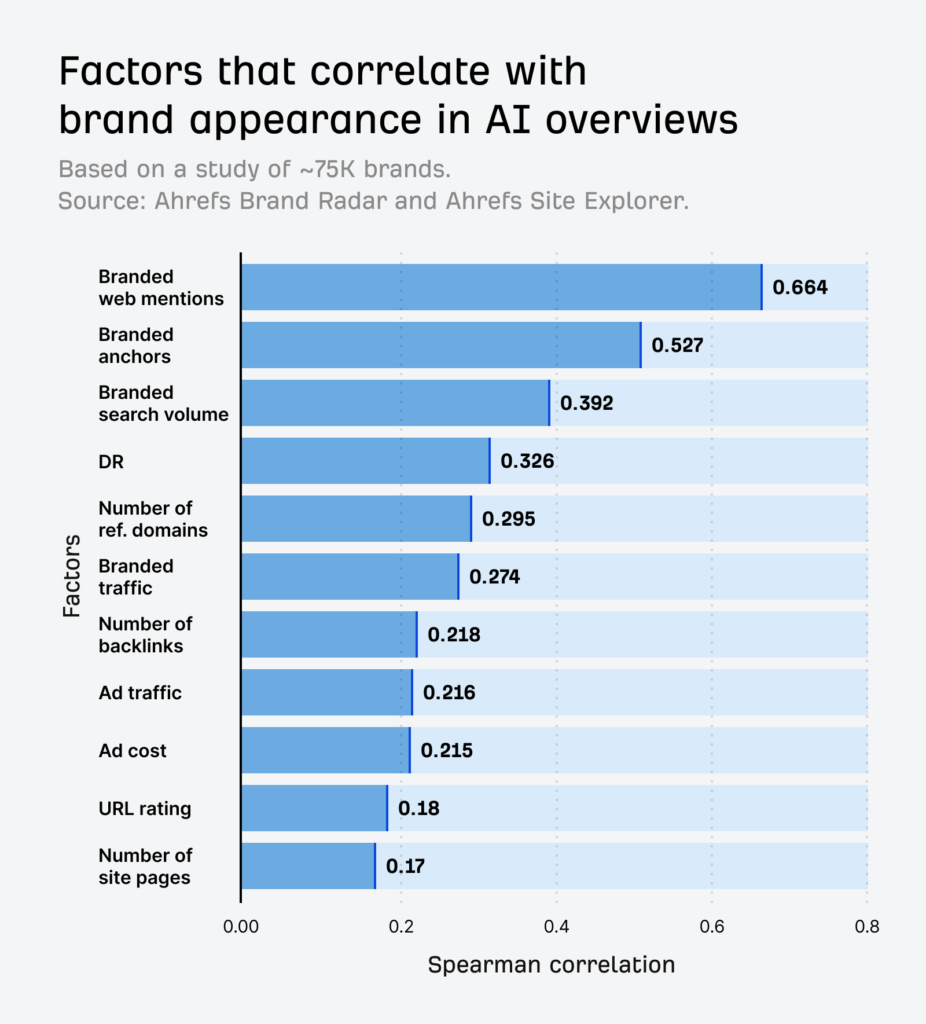
Read only those two numbers and the conclusion writes itself: links lost, mentions won, stop building links. That conclusion misses the most useful line in the dataset.
Between the two sat branded anchor text — a link whose surrounding copy names the brand — at 0.527, nearly two and a half times the correlation of generic backlinks. Think about what that number is describing. Technically it isn’t a different kind of link; it’s a link that lives inside real editorial content, in a passage that names the brand and says something about it. A link like that carries both signals at once: the link the retrieval systems read, and the mention the language models absorb. The two consumers of the trust graph each get what they need from a single placement.
So the data doesn’t say links stopped mattering. It says something more specific and more actionable: what stopped mattering is the link without context. A URL dropped into a footer, an author bio, or a page of link-farm filler passes a vote nobody counts anymore. A link embedded in genuine editorial coverage that names and describes the brand was, after mention volume itself, the strongest off-site factor the study measured.
(The usual honesty note applies: these are correlations, not proven causes. But when two independent study waves across three AI platforms rank the factors the same way, the direction is clear enough to plan budgets around.)
The kind of link that works in both systems
Translate the data into a purchasing standard and you get three requirements. In our placement reviews, these are the three things we check before anything else, because they decide whether a placement earns value in one system, both, or neither:
1. It lives inside real editorial content. Not a link page, not a sponsored-content section walled off from the publication’s actual readership, not five hundred words of filler wrapped around an anchor. Retrieval systems assess the page the link sits on; language models learn from the passage around it. If the page exists only to hold links, both consumers discount it.
2. The surrounding copy names the brand and repeats its core claims. This is corroboration — the same signal that anchors our GEO framework. A passage that says who the company is, what it does, and for whom, in wording consistent with the brand’s own site, is teaching every future model that reads it. The 0.527 figure is, in effect, the measured value of this habit.
3. The publication itself survives scrutiny. A mention on a site that publishes anything for anyone corroborates nothing — testimony from a witness nobody believes. This is the requirement that can’t be checked from a metrics dashboard: DR and traffic estimates don’t tell you whether a site has editorial standards. Someone has to look.
None of the three can be bought from a spreadsheet of domains. They can only be verified placement by placement, before money moves — which is the entire reason our workflow is approve-first: you review the publisher and the placement context before an order proceeds, not after. (Disclosure: EggROI operates a placement service for editorially reviewed guest posts, so we have a commercial interest in this standard — and a daily view of how often cheap placements fail it.)
Placement decides AI presence
One more implication of the data deserves its own section, because it changes how campaigns should be planned: where a claim appears now matters as much as whether it appears.
The same brand description, placed on two different sites, is not the same asset. On a publication that AI engines already treat as authoritative, it becomes corroborating evidence — a source the retrieval layer will pull and the training layer will weight. On a site with no standing, it’s a page that exists. Nothing about the writing changed; the entire difference is the placement.
This is also where outlet category starts to matter. News and finance publications appear to occupy a distinct tier in how answer engines source claims about companies — how AI engines treat news sources is a topic we’ll cover separately — and placements on them do a different job than blog placements: less about passing authority to a URL, more about putting the brand’s story somewhere the machines demonstrably read. It’s the logic behind treating premium press placements as a distinct product from guest posts rather than an expensive version of the same thing.
For planning purposes, the practical rule is simple: match the placement to the job. Guest posts on relevant editorial sites build the corroborated, contextual link profile the data favors. Press placements put consistent brand facts into the highest-trust tier of the source pool. A campaign that does only one is optimizing for one consumer of the trust graph and ignoring the other.
Frequently asked questions
Do nofollow links help AI visibility? More than they help rankings. The mention signal — a brand named and described in credible editorial content — doesn’t depend on the link’s rel attribute; language models absorb the passage either way, and retrieval systems still see the source. A nofollow placement on a strong publication can carry real GEO value while passing little classic link equity. Judge it by the mention, not the attribute.
Are backlinks dead for SEO? No. Traditional rankings still consume the link graph the way they always have, and rankings still drive discovery — including discovery by the retrieval systems behind AI answers. What the data challenges isn’t links; it’s contextless links. If a link would embarrass you when a human reads the page around it, a machine won’t value it either.
Which matters more — links or brand mentions? It’s a false choice. After mention volume itself, the strongest off-site factor in the Ahrefs data was the branded anchor — a link and a mention in the same placement. Buy the placement that carries both instead of choosing between them.
The link’s job changed from vote to evidence
Backlinks still matter for AI search — but the job description changed. A link used to be a vote, counted by one algorithm to order a results page. Now it’s evidence: proof, legible to both retrieval systems and language models, that independent sources know your brand, describe it consistently, and consider it worth writing about. Votes could be accumulated. Evidence has to be placed — in real editorial content, with the brand named, on publications that survive scrutiny.
That’s a higher standard than link building used to demand, and it’s the standard we built our approve-first placement process around: see every publisher and every placement context before your budget commits, because in a world where machines read the whole page, the whole page is what you’re paying for.

EggROI Editorial Team
The EggROI editorial team reviews publisher quality, placement context, and content citability across the guest post and press placements we process. Everything we publish follows the same standard we apply to client work: sourced data, disclosed interests, and no fabricated statistics.