
How to Vet a Website Before You Pay for a Placement (The Three-Check Standard)
You found a site with DR 65. The seller wants $300 for a placement. Is that a good deal — or are you about to pay for a link on a site Google already ignores? Most buyers can’t tell the difference. And that’s not on you. Sellers lead with the one metric that’s easiest to...
 By Atimmy
· 8 min read

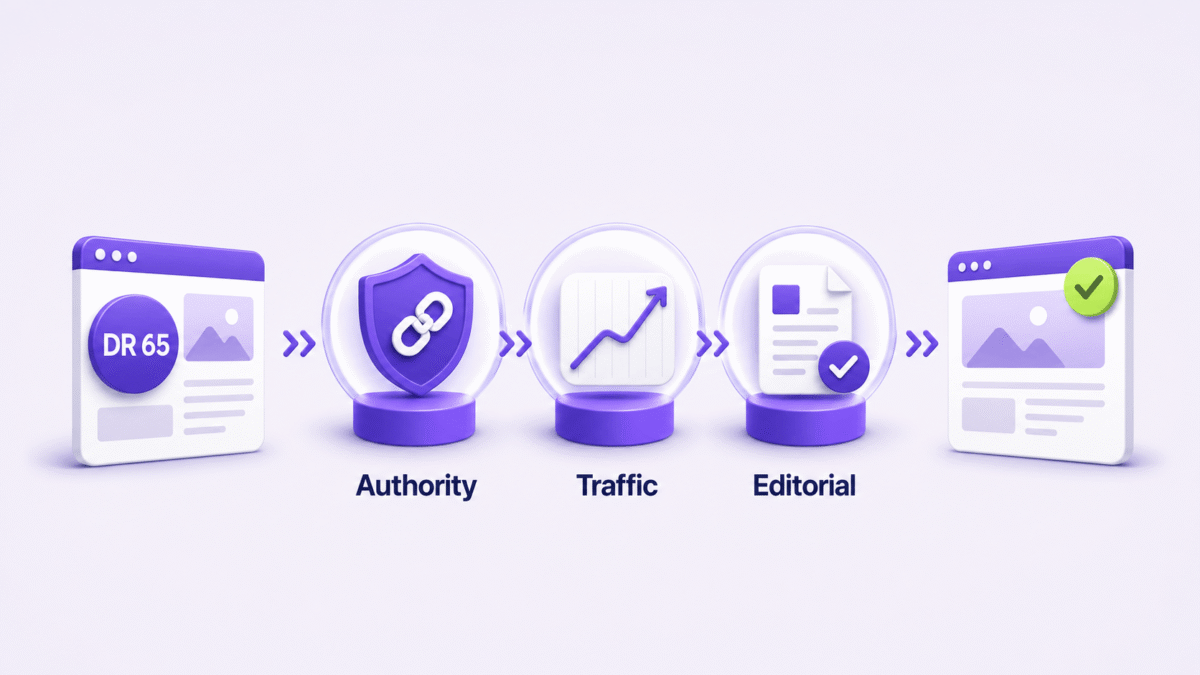
You found a site with DR 65. The seller wants $300 for a placement.
Is that a good deal — or are you about to pay for a link on a site Google already ignores?
Most buyers can’t tell the difference. And that’s not on you. Sellers lead with the one metric that’s easiest to inflate, and unless you do SEO every day, you have no practical way to check what’s behind it.
I’ve spent 15 years vetting sites for exactly this, and the framework hasn’t changed much. It’s three checks. A site passes all three or it doesn’t get used.
In this guide, I’ll cover:
- Why a DR number alone can mislead you
- Check 1: Authority is real
- Check 2: Traffic is organic
- Check 3: Editorial is clean
- The copy-paste checklist
- What “two out of three” actually costs you
How Do You Vet a Website Before Buying a Placement? (The Short Answer)
To vet a website before paying for a guest post placement, check three things: that its authority is real (DR is backed by genuine referring domains, not spam links), that its traffic is organic (real search visits on relevant topics, not bots or bought clicks), and that its editorial is clean (no link-farm footprint, no off-topic sponsored sprawl). A site must pass all three — a strong score on one check does not make up for a failure on another.
That’s the whole framework. The rest of this guide shows you how to run each check, and what the red flags look like.
Why a DR Number Alone Can Mislead You
Domain Rating measures the strength of a site’s backlink profile. That’s it.
It doesn’t measure whether Google trusts the site. It doesn’t measure whether real people read it. And it definitely doesn’t measure whether a link from it will do anything for you.
The gap is bigger than most buyers expect. Ahrefs studied around 14 billion webpages and found that 96.55% of them get zero traffic from Google. Plenty of those zero-traffic pages sit on sites with respectable-looking authority scores.
A metric can be purchased. An audience can’t.
And here’s the part almost nobody selling links will tell you: even honest metrics are estimates. Ahrefs compared its own traffic numbers against Google Search Console data across 1,635 websites and found a median deviation of 49.52% — though the correlation was a strong 0.76.
In plain English: the tools are directionally reliable and absolutely worth using. But the exact number on your screen can be off by half.
That’s why I keep saying quality is a decision, not a badge. Metrics give you context. They don’t make the call for you.
Here’s how to make the call.
Check 1: Authority Is Real
The question you’re answering: is this DR earned, or manufactured?
DR can be inflated cheaply. A few hundred links from expired domains will move the number without creating anything Google values. So don’t read the score — read what’s underneath it.
Look at the referring domains, not the count. Open the site’s backlink profile in Ahrefs, Semrush, or Moz. Scan the top referring domains. Are they recognizable sites in plausible niches? Or a wall of zero-traffic domains with names like best-seo-links-4u?
Check the link velocity. A site that gained 800 referring domains in one month, and nothing before or after, didn’t get popular. It bought a link package.
Cross-check across tools. A site that looks like DR 60 in one tool and DR 20 in another is telling you something. Genuinely strong sites look strong everywhere.
See who they link out to. If the site’s existing outbound links point at casinos, essay mills, and payday loans — your link will live in that neighborhood too.
Red flags: sudden link spikes, zero-traffic referring domains, big cross-tool disagreement, toxic outbound neighbors.
Check 2: Traffic Is Organic
The question you’re answering: do real people arrive here from search — for topics related to yours?
A site can pass the authority check and still be invisible. When Google stops trusting a site, the traffic disappears but the authority score often stays frozen in place. That’s the trap.
Pull the trend, not the snapshot. One number hides everything. What you want is the 2-year traffic graph. Healthy sites are stable or growing. A cliff — traffic down 70% in a month — usually marks an algorithmic demotion. Walk away, whatever the DR says.
Check what the site ranks for. Open its top organic keywords. A home-improvement blog ranking for home-improvement terms is healthy. A “business site” whose top keywords are celebrity net worths and song lyrics has an audience that will never care about your brand.
Check where the traffic comes from. If you sell to the US and UK, a site with 90% of its visits from countries you don’t serve gives your link far less contextual value.
And remember the estimate problem. A site showing 8k monthly visits might really get 4k, or 12k. That’s fine. What matters is that the traffic is real, relevant, and not falling off a cliff.
Red flags: traffic cliffs, off-topic rankings, geography that doesn’t match your market.
Check 3: Editorial Is Clean
The question you’re answering: does this site behave like a publication — or like a link vending machine?
This check matters more in 2026 than it ever has.
In March 2024, Google introduced its site reputation abuse policy, targeting what the industry calls “parasite SEO” — third-party content published on a site mainly to ride the host’s ranking signals. Enforcement was immediate, and it reached household names: manual penalties hit sections of Forbes, CNN, Time and The Wall Street Journal in late 2024.
Then Google went further. In November 2024 it clarified that no amount of first-party oversight exempts content designed to piggyback on a host site’s rankings.
The message for buyers is blunt: if a site’s editorial is obviously for sale to anyone, Google is actively working to make links from it worthless. Even when the site is famous.
Read three recent articles. Actually read them. Are they written for a reader — or are they 600-word wrappers around three unrelated commercial links?
Scan the categories. A gardening blog with sudden sections for crypto, CBD, and online casinos isn’t diversifying. It’s selling placements to anyone who pays.
Check the authors. Real publications have recurring authors with some identity. A site where every post is by “Admin” has no editorial layer at all.
Look at outbound link density. Unrelated do-follow commercial links in every single post is the clearest single tell there is.
Red flags: content written for links rather than readers, casino/CBD category sprawl, no real authors, commercial links in every post.
📋 The copy-paste checklist
Authority is real
☐ Top referring domains look like real sites
☐ No unexplained link spikes
☐ Metrics roughly agree across tools
☐ Outbound neighborhood is cleanTraffic is organic
☐ 1-year trend is stable or growing (no cliff)
☐ Top keywords match the site’s actual topic
☐ Traffic geography matches your marketEditorial is clean
☐ Recent articles are written for readers
☐ Categories are coherent — no casino/CBD sprawl
☐ Recurring, identifiable authors
☐ No pattern of unrelated commercial links per postThe rule: all three must pass. Two out of three is a fail.
What “Two Out of Three” Actually Costs You
Each partial pass fails in its own way. It’s worth spelling out:
Real authority + fake traffic = a site Google has quietly demoted. Your link exists. Nobody ever sees the page.
Real traffic + dirty editorial = a site living on borrowed time under the site reputation abuse policy. You’re buying into a neighborhood Google is actively clearing out.
Clean editorial + no authority or traffic = a lovely small blog whose link is worth roughly what its audience is: not much yet. Sometimes still worth it for pure relevance — but price it like what it is.
A placement only compounds when the site is credible to Google, visible to people, and coherent as a publication. All at the same time.
Skip the two hours of vetting per site. Here at EggROI, every listing has already passed this exact three-check standard — sites that fail never reach the marketplace. You see the context that matters (authority, traffic, topic, market, price) side by side, and you make the call. Browse verified placements →
Frequently Asked Questions
How long does it take to vet one site properly?
With tool access and practice, 15–25 minutes per site. Without practice, closer to an hour. That’s the honest reason vetting gets skipped when brands buy from spreadsheets of 200 domains — and why we moved it upstream into the listing process instead.
Which tools do I need?
Any one major backlink tool — Ahrefs, Semrush, or Moz — covers checks 1 and 2. Check 3 needs no tools at all. Just read the site. It’s the step most buyers skip, and it catches the most problems.
Is a low-DR site ever worth buying?
Sometimes, yes. A DR 25 site that passes all three checks — real niche audience, clean editorial, genuine relevance to your product — can outperform a DR 60 site that limps through two. Relevance isn’t a consolation prize.
Atimmy Tsai is the founder of EggROI and has spent 15 years in editorial link building, including a decade serving the North American market. EggROI is a marketplace for verified guest post placements and digital PR, built for brands that buy direct
Atimmy
Atimmy is the founder of EggROI and an SEO practitioner with more than 15 years of experience across Canada and Asia. He writes about publisher quality, link building, digital PR, and the practical decisions behind safer, more effective off-page campaigns.