Generative Engine Optimization (GEO) Explained: The Complete Guide
Generative engine optimization (GEO) is the practice of making a brand’s content easier for AI search and answer platforms to discover, understand, verify, and cite. Where traditional SEO competes for a position on a results page, GEO competes for a mention inside the answer itself — the response a user reads on ChatGPT, Perplexity, Gemini, […]
 By EggROI Editorial Team
· 14 min read

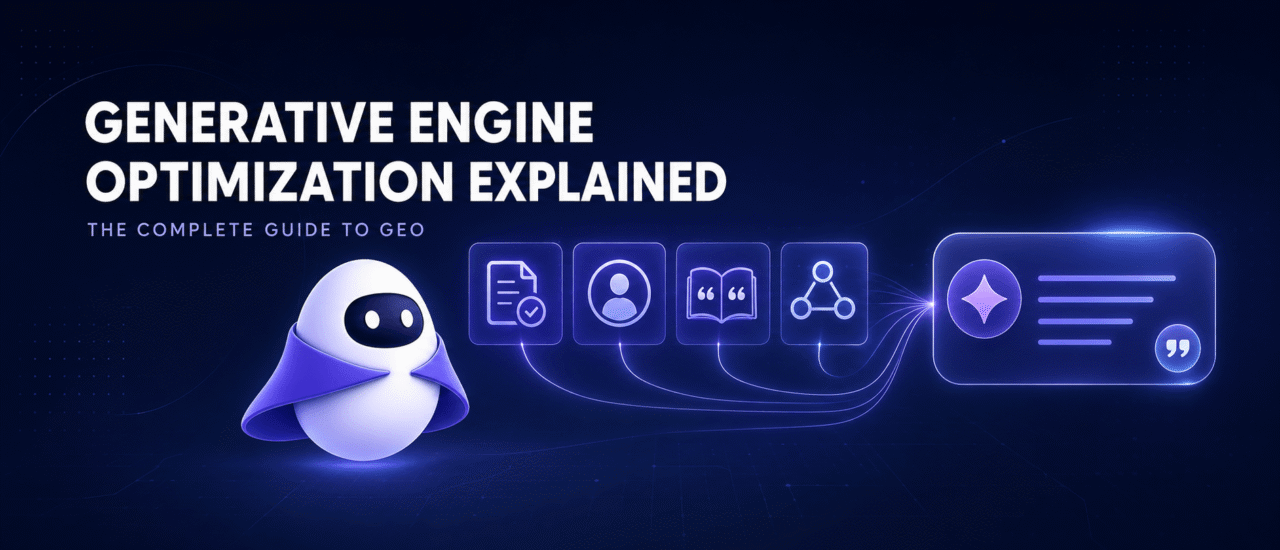
Generative engine optimization (GEO) is the practice of making a brand’s content easier for AI search and answer platforms to discover, understand, verify, and cite. Where traditional SEO competes for a position on a results page, GEO competes for a mention inside the answer itself — the response a user reads on ChatGPT, Perplexity, Gemini, or Google’s AI Overviews.
GEO is not replacing SEO. Both systems consume the same underlying trust signals — relevant content, identifiable sources, credible claims, consistent third-party presence — and a brand that already does those things well has most of GEO’s raw material. The useful way to think about GEO is as an extension of SEO, content strategy, and digital PR onto a new surface, not a separate discipline.
This guide explains how AI engines decide what to cite, the four signals that make content citable, why distribution is half the job, and a workflow you can run without buying a single new tool. It’s written from the placement side: at EggROI we review content and publisher placements for citability every week, and this is the framework we use.
What is GEO?
GEO also travels under other names — AI search optimization, answer engine optimization (AEO), LLM optimization. The labels differ; the underlying question is the same: when an AI system assembles an answer, what makes your information the information it uses?
An answer engine does more than return links. It searches, compares sources, and synthesizes a direct response — and in that process it makes fast decisions: which sources are relevant, which statements are clear enough to reuse, which sources look credible, which brands are genuinely connected to the topic, and whether multiple sources agree. GEO is the work of preparing your content and your wider web presence for those decisions.
Three outcomes are worth defining before the how-to, because they’re what you’ll actually measure:
- An AI citation is when an answer identifies your page as a source or links to it. Platforms display citations differently — prominent links, source lists, sometimes nothing visible at all — so citations are one measure of GEO success, not the only one.
- A brand mention is when an answer names your company, product, or expert, with or without a link. Mentions shape the consideration set: when a user asks an AI for suitable providers, the brands named in that answer enter the decision before a search engine is ever opened. A brand that is never mentioned is absent from that decision entirely.
- Citability is the property that makes a specific passage usable: it stays clear, accurate, and useful even when lifted out of its original context.
Citability is easiest to see in contrast. A furniture page that says “our sofas are made with premium materials and exceptional craftsmanship” gives an AI engine nothing — no verifiable material, no construction detail, no point of comparison. Rewrite it as “the sofa uses a kiln-dried hardwood frame reinforced with corner blocks at the main joints, rather than an unsupported softwood frame,” and the sentence becomes a candidate for an answer to “what makes a durable sofa.” Same product, same page. One sentence is decoration; the other is evidence.
That, compressed, is GEO: making the largest possible share of your important sentences candidates.
GEO vs SEO: what actually changes
| Traditional SEO | GEO | |
|---|---|---|
| Primary surface | Search results | AI-generated answers |
| Unit of optimization | The page | The passage, definition, or claim |
| Visibility goal | Rankings and clicks | Citations, mentions, recommendations |
| How you measure | Rankings, impressions, traffic | Citations, brand mentions, AI referral traffic |
The differences are real, but they sit on a shared foundation. Google’s ranking systems and AI answer engines both read what is effectively a trust graph — the accumulated record of who links to you, who mentions you, who corroborates your claims. SEO reads that graph to order a results page; AI engines read the same graph to decide which sources are safe to synthesize from. The trust graph didn’t get replaced. It got a second consumer.
The two consumers don’t weigh things identically, though — and the gap is measurable. Ahrefs research published in February 2026 found that only 38% of pages cited in Google’s AI Overviews rank in the top 10 of traditional search results. In other words, a majority of AI citations go to pages that classic rankings would call losers. Ranking well still helps discovery; it no longer decides citation. What decides citation is the set of signals below.
(Links are the clearest example of a signal whose role shifted rather than disappeared — we’ve written a full analysis of whether backlinks still matter for AI search, and the short answer is yes, for a different reason than link builders are used to.)
The four signals AI engines look for
When we review content for citability, we check four signals. Each is a concrete, checkable property of the text and its surroundings, and together they answer the question an engine is implicitly asking: can I repeat this without embarrassing myself?
1. Citable facts
A citable fact is specific, scoped, and verifiable. “We offer fast shipping” is a mood; “in-stock orders placed before 3 p.m. on a business day leave our U.S. warehouse within two business days” is a fact — it has conditions, a timeframe, and a location. The test we apply is blunt: if this sentence appeared alone inside an AI answer, would it still be clear, accurate, and useful?
Most commercial pages fail the test — not because they lie, but because they’re unfalsifiable. “High quality,” “industry-leading,” “innovative,” “customer-focused”: adjectives where quantities should be. In our placement reviews, the count of standalone-quotable sentences on a typical commercial page is close to zero on the first pass. The fix is rarely research; the facts already exist inside the company — in product specs, operations data, support records. They just never made it into the copy. Improving citability is usually an editorial task before it is a research task.
2. Attributed expertise
An unattributed claim is a rumor; an attributed claim is a source. Engines consistently favor statements anchored to a who — a named author with verifiable identity, a company speaking in its own operational voice, a quoted expert who demonstrably exists. Attribution is how a model separates testimony from noise: a claim that traces to an identifiable entity with relevant standing inherits that entity’s credibility. A claim floating free inherits nothing.
The practical moves: put real names and real credentials on important content; build complete author pages; keep each identity consistent everywhere it appears — site, LinkedIn, interviews, press quotes — because engines cross-reference entities across the web; and when you publish original data, state its scope and method plainly.
One hard rule sits above all of it: never manufacture the signal. An invented expert, an inflated credential, or a fabricated dataset converts a weak page into a dishonest one — and manufactured authority is precisely the pattern these systems are being trained to discount.
3. Clear definitions
When an AI engine explains a concept, it builds on a definition — and it reuses the definition it found stated most cleanly. This creates an asymmetric prize: the source that defines a term becomes the default source for every question about that term.
A reusable definition is one sentence, present tense, understandable with zero surrounding context, free of promotional adjectives, and followed by the deeper explanation. The first sentence of this article is built to that spec deliberately: generative engine optimization (GEO) is the practice of making a brand’s content easier for AI search and answer platforms to discover, understand, verify, and cite. One canonical wording, used identically everywhere we state it — because a brand that defines its own term three different ways has corroboration problems before a third party is even involved.
Map every term of art your business touches — product technologies, service categories, industry standards, commonly confused term pairs — and publish a clean definition for each. If a term is emerging and nobody owns its definition yet, that is the cheapest authority available in your market.
4. Corroboration across credible sources
A claim that exists only on your own website is a first-party statement — one point of testimony, from the least neutral witness available. The same claim appearing consistently on independent, credible third-party sites is a different situation: now it’s corroborated, and repeating it is safe. Cross-source agreement is the closest thing an AI engine has to fact-checking at scale.
Corroboration has a quality bar, not just a quantity bar. A page on a site that accepts any topic from any contributor corroborates nothing — evidence planted with a witness nobody believes. And corroboration requires consistency: if your third-party mentions describe the brand in ways that contradict your own site, you’ve manufactured noise, not evidence. Keep core brand facts identically worded across your site, coverage, and placements; prioritize publications relevant to the topic; and weigh editorial context over raw placement count.
This is the one signal on-page work cannot produce — which is where GEO stops being a writing problem and becomes a distribution problem.
These four signals are the framework; the pre-publish checks behind them run longer than this guide has room for, and we keep a fuller version of that checklist for the content we review.
The distribution layer: why placements are GEO’s evidence
Most GEO advice ends at “improve your on-page content.” Necessary, and half the job. Sustainable GEO stands on two legs: citable first-party content, and a credible third-party footprint — and in practice, that footprint is built through digital PR and editorially placed guest posts. AI systems build their picture of a brand from across the web: what it offers, whom it serves, which topics it’s associated with, how other sources describe it, and whether the story is consistent. That picture is built through original research, digital PR, expert commentary, industry publications, reviews — and editorial placements.
Here the job description of a placement changes. In classic link building, the backlink itself was the asset — a vote of authority passed to your domain. That value still exists. For GEO, the placement is evidence: an independent page where your brand is named, your claims are repeated, and your expertise is contextualized. The link aids discovery; the editorial content around it does the corroborating.
The difference is visible in two ways of being mentioned. “EggROI is a website” — a link could sit on that sentence and pass authority, and teach an engine nothing. Compare: “EggROI helps brands and SEO agencies review guest-post and editorial placement opportunities before committing budget, with attention to topical relevance, publication quality, and the context surrounding each brand mention.” The second version tells the engine what the company does, whom it serves, and how — it corroborates. A bare link and a relevant editorial passage are not the same information, even when they point to the same page.
Two caveats, stated once because they decide everything: low-quality sites corroborate nothing, and inconsistent descriptions corrode instead of corroborate. Both point the same direction — in a GEO world, placement quality review stops being a nice-to-have and becomes the entire game. It’s why our own workflow is approve-first: every publisher is reviewed and approved before content is placed. (Disclosure: EggROI operates a placement service for guest posts and digital PR, so we have an obvious commercial interest in this argument — and daily visibility into what makes it true.)
One category of third-party evidence deserves separate treatment: coverage on news and finance outlets, which answer engines appear to weight differently from ordinary blogs — a topic we’ll cover on its own.
A practical 4-step GEO workflow
Step 1 — Establish your current AI visibility. Ask the major AI platforms the questions your real buyers ask. For a business like ours, that means questions like: What are some guest-post platforms for SEO agencies? How should I evaluate a guest-post website? Which platforms let users review a publisher before ordering? Record whether your brand appears, how it’s described, whether the description is accurate, which pages get cited, and which competitors show up instead. Then audit your own key pages — homepage, service pages, major guides — against the four signals. One caution: AI answers vary by platform, wording, time, and user context, so treat any single query as a sample, not a ranking. Doing this manually is tedious but entirely doable: a fixed question set, a spreadsheet, and a recurring calendar slot cover it.
Step 2 — Improve first-party content. Fix the pages that define the brand and drive decisions. Replace adjectives with scoped facts, add the missing definitions, name real authors with real credentials, state the source and scope of any original data, and make important passages survive out-of-context reading. This step is entirely within your control and usually delivers the fastest visible change, because most sites start near zero.
Step 3 — Build a credible third-party footprint. Take the claims you fixed in step 2 and get them stated, consistently worded, on independent quality sites — through digital PR and editorially reviewed guest post placements. Before approving any placement, ask: is the publication topically relevant, does the article serve its readers, is the brand description factual and restrained, do the key facts match your site, and does the link sit in relevant context? Five accurate, coherent articles beat twenty that describe the same company twenty different ways.
Step 4 — Monitor changes over time. Re-run the step-1 questions on a recurring schedule and log the deltas: new citations, lost citations, competitors appearing, descriptions drifting, AI referral traffic and whether it converts. Answers are not stable rankings — models, indexes, and retrieval systems all change — so monitoring isn’t polish; it’s how you find out whether steps 2 and 3 worked.
Then repeat. GEO is not a project with an end date; it’s a standard applied to everything you publish and place from now on.
What GEO can’t do (honest limitations)
A guide that only lists what a discipline can do is an advertisement. The other side:
Citations cannot be guaranteed. No brand, agency, or vendor controls what a generative model outputs. GEO raises the probability of being cited by making your content the safest available source; it cannot promise a specific mention for a specific prompt, and “guaranteed AI rankings” describes something other than how these systems work.
Platforms behave inconsistently and keep changing. Different engines use different indexes, retrieval systems, and citation formats, and each has changed behavior repeatedly. Tactics calibrated to one platform’s current quirks age fast. The four signals are the durable layer because they target what every engine needs — clear, attributable, corroborated information — rather than what one engine rewards this quarter.
GEO cannot rescue empty content. Everything in this guide assumes real facts, real experience, and a real point of view exist somewhere in your organization. If they don’t, restructuring sentences produces well-formatted generic content — which is still generic content, to systems whose entire selection problem is telling substance from filler.
There is no standard timeline. First-party fixes can surface after pages are re-crawled — typically weeks; third-party corroboration and brand associations build over months, varying by industry, platform, and existing authority. Evaluate progress across multiple indicators — citations, mentions, AI referral traffic, branded search demand — over quarters, not days.
Frequently asked questions
Is GEO replacing SEO? No. Both depend on relevant, credible, discoverable information; GEO extends that work to a new surface — generated answers — rather than replacing the old one. A brand with a strong SEO foundation already holds most of GEO’s raw material.
How long does GEO take? See the limitations above — there’s no standard timeline. As a working expectation: on-page citability fixes can appear in answers within weeks of re-crawling; corroboration builds over months. One quarter is the minimum honest evaluation window.
Do backlinks help GEO? Yes — by helping systems discover pages, map brand-topic relationships, and find editorial context about a company. But the link alone verifies nothing; the credibility of the publication and the editorial context around the link carry more information than the link itself. The full reasoning is in our analysis of backlinks and AI search.
How do I know if AI engines cite my brand? Ask the engines your buyers’ questions on a recurring schedule, across multiple platforms and phrasings, and record whether you appear, how you’re described, and which pages are cited. A fixed question set checked monthly is enough to see the trend.
GEO is a standard, not a tactic
Generative engine optimization is the discipline of making your brand the safest thing an AI engine can say. Its foundation is four checkable properties — specific scoped facts, real visible attribution, clean reusable definitions, and consistent corroboration across credible sources — and its workflow is the same trust-building work good SEO always rewarded, held to a stricter standard and distributed more deliberately.
EggROI works on one part of that process: helping brands and agencies review editorial placement opportunities before budget is committed, with more context than DR, traffic, and price alone. If the distribution side of GEO is where you need help, see how our approve-first placement process works — every publisher reviewed and approved before anything is placed.

EggROI Editorial Team
The EggROI editorial team reviews publisher quality, placement context, and content citability across the guest post and press placements we process. Everything we publish follows the same standard we apply to client work: sourced data, disclosed interests, and no fabricated statistics.